Modern Ops: Gun Shooting Games
- 4.7
- Rating
- 100.00M
- Installs
- Free
- Price
 Analysis by App-foxy
I approached Modern Ops: Gun Shooting Games as a quick-action mobile shooter rather than a long story-driven campaign. That distinction matters from the first minute: the game is built around getting into gunfights quickly, learning the controls through repetition, and improving your decisions one match at a time. It is free to download, carries a Teen content rating, and comes from Edkon Games GmbH. For someone who wants a modern military-style FPS on a phone without committing to a large, complicated game, it makes a convincing first impression.
The game’s popularity is easy to understand. It has passed over 100 million installs, holds a 4.7 average from around 1.5 million ratings, and has accumulated roughly 39 thousand written reviews. Those figures do not guarantee that every player will enjoy it, but they do suggest that the basic formula has reached a very broad audience. My own recommendation is more specific: try it if you enjoy short, competitive shooting sessions and are willing to spend time adjusting your aim. Skip it if you mainly want a relaxed offline experience, a deep single-player story, or a shooter with no pressure from competitive play.
What to expect when you start playing
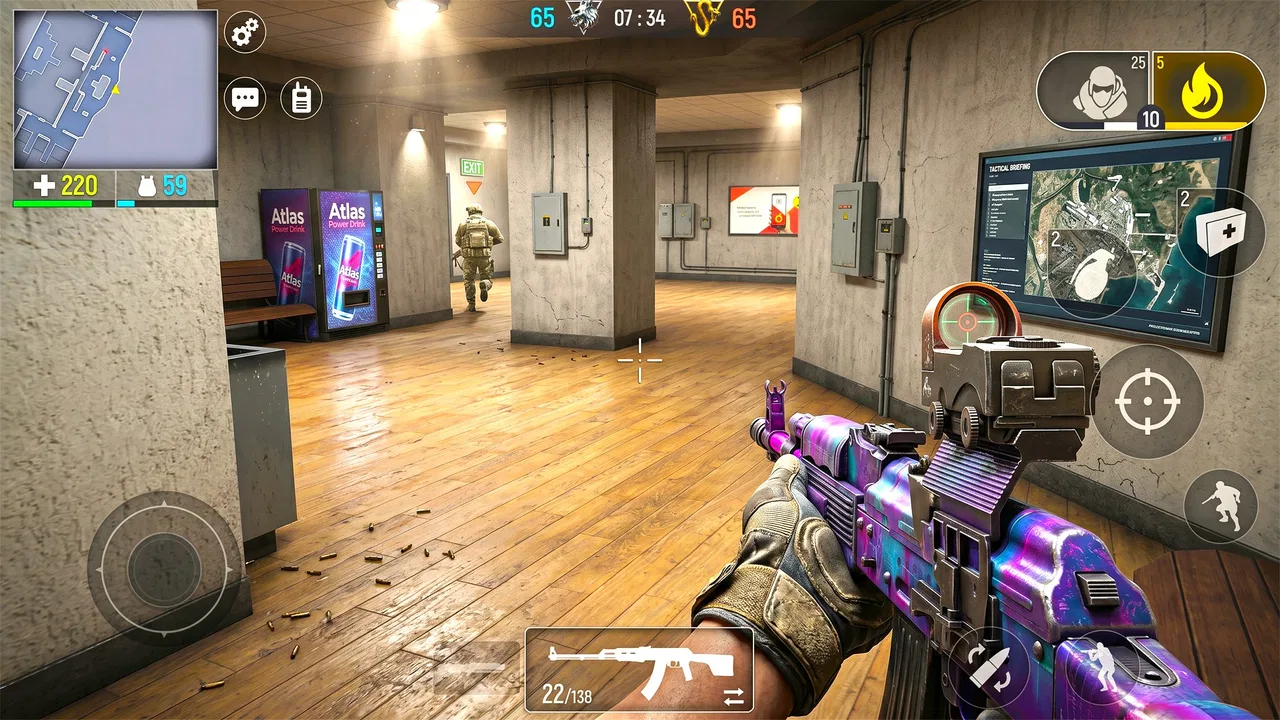
The opening experience is focused on action rather than explanation. You are not asked to learn a large role-playing system before firing a weapon. Instead, the important early tasks are practical: understand how movement feels, learn where the shooting controls sit, recognize the rhythm of an encounter, and discover how quickly an exposed player can be punished. That makes the game approachable, but it also means the first few sessions can feel demanding if mobile shooters are new to you.
You May Also Like

 AccuWeather: Weather Radar
AccuWeather Review: A Quick, Clear Forecast for Everyday Decisions
For everyday plans, the best forecast is the one you can understand quickly. AccuWeather makes rain timing, radar, and local conditions easy to act on, with a few trade-offs.

 Hill Climb Racing
Why Hill Climb Racing Still Turns Crashes Into One More Run
A tiny car, a bumpy hill and one more upgrade: Hill Climb Racing keeps resurfacing because its simple chaos makes every near-miss feel personal.

 AliExpress - Shopping App
AliExpress Makes Global Shopping Feel Personal, but Shoppers Bear the Risk
AliExpress turns a global marketplace into a pocket-sized discovery engine. Its reach is useful, its shopping loop compelling, and its trade-offs easy to miss.

 Lords Mobile: Kingdom Wars
Lords Mobile Is a Kingdom-Building Routine, Not a Quick Match
A case-by-case verdict on the building, battles, device demands, and social commitments that make Lords Mobile rewarding for some players and exhausting for others.

 PDF Scanner app - TapScanner
TapScanner Makes Paperwork Easier to Capture, Check, and Share
TapScanner makes scanning with a phone feel less like a rescue operation and more like a dependable step in getting work done. Its capture tools are useful, though not flawless.

 Block Blast!
 Shows How Much a Puzzle Game Can Leave Out
A quiet grid game shows why puzzle players increasingly value instant clarity, repeatable skill and low-pressure play—and where the genre still needs to catch up.
More From Our News Desk
View All News


I found the strongest part of the design to be its immediacy. A short break can be enough time to play, and the game does not require the same long commitment as a console-style campaign. This is useful for a commute, a waiting room, or an evening when I want a few rounds rather than an elaborate gaming session. The trade-off is that quick matches can encourage impulsive play. If I rushed forward without checking angles or controlling my aim, the action became frustrating very quickly.
Modern Ops belongs firmly in the action FPS category. Its appeal comes from weapon handling, positioning, reaction speed, and the satisfaction of winning an exchange. It is less suitable for a player who prefers turn-based tactics or a slow, methodical military simulator. Even when I tried to play carefully, I still had to respond quickly once a fight began.
The presentation also sets a particular expectation. This is a contemporary gun game, not a cartoon arena with harmless-looking equipment. The Teen rating is worth taking seriously for younger players and families. Anyone choosing it for a child should consider whether realistic shooting action is appropriate, rather than relying only on the fact that the download itself is free.
The first setup should be treated as practice
When I begin a mobile shooter, I resist the temptation to judge it by the first few seconds of movement. Touch controls rarely feel natural immediately. My advice is to use the opening period to find a comfortable grip and decide which thumb should handle movement and which should handle aiming. Even a small change in hand position can determine whether I can track an opponent or accidentally drag the view away from the target.
Do not make your first goal a high score. Make it consistency. I start by moving in short bursts, turning the camera deliberately, and checking whether my aim stays where I expect after changing direction. This is more useful than charging into every visible fight. The first meaningful improvement usually comes from reducing accidental swipes, not from learning an advanced trick.
Players who already know mobile shooters may want to adjust their control habits immediately. New players should avoid changing everything at once. Alter one setting or one movement habit, test it for several encounters, and then decide whether it helped. Changing multiple controls together makes it difficult to understand what actually improved the experience.
The game runs on Android from version 8.0 onward, which makes it accessible to a wide range of compatible phones. Still, compatibility is not the same as comfort. A device may launch the game successfully while its screen size, touch response, or performance makes aiming difficult. If the first session feels rough, I would first check whether the problem is my control technique before blaming the game, but I would also accept that some phones are simply better suited to fast shooters.
Another practical point is spending. The game is free, but its in-app purchases range from $0.99 to $199.99 per item. I would begin without buying anything and learn what the normal progression feels like. That gives a clearer sense of whether a purchase would genuinely improve my enjoyment or merely shorten a process I had not yet understood. For families, the purchase range is a good reason to use the device’s normal purchase safeguards.
How I reached the first successful action
For a beginner, a successful action should not mean dominating a whole match. A better first milestone is winning one direct encounter because you made a sensible choice. I look for cover, avoid standing in an obvious open lane, and wait until my aim is reasonably stable before firing. That simple sequence is more reliable than spraying while moving without a plan.
My first useful routine is to move, stop briefly, aim, and then fire. Constant movement can make a player harder to hit, but it can also make the camera difficult to control. The short pause gives the crosshair a chance to settle. Once that feels comfortable, I add movement back into the exchange in small amounts instead of trying to run and aim perfectly at the same time.
Another effective habit is to treat the edge of cover as a decision point. I do not expose the entire character just to see what is happening. I peek, identify the likely direction of danger, and retreat if the angle looks unfavorable. This is especially helpful for new players because it turns a chaotic firefight into a series of smaller choices. The goal is not to be passive; it is to avoid giving an opponent an effortless target.
When I lose an encounter, I try to name the reason in plain language. Was my aim too low? Did I enter a lane without checking it? Did I keep firing after the target moved out of sight? Did I stay exposed too long? This quick review is more valuable than immediately starting another match with the same habit. Mobile shooters reward repetition, but only when repetition includes correction.
Players often ask whether they need previous FPS experience. I do not think they do. Prior experience will make the controls and pacing easier to understand, but a beginner can make progress by focusing on one skill at a time. Start with camera control, then positioning, then timing. Trying to master all three during the first session usually creates unnecessary frustration.
Common confusion that can make the game feel harder
The biggest early confusion is the difference between seeing an opponent and being ready to shoot. On a phone, the camera may reveal a target before your aim is aligned. Pulling the trigger immediately can waste the opportunity. I get better results by allowing a fraction of a second to bring the target into a comfortable position, especially when the opponent is moving across the screen.
A second source of frustration is assuming that aggressive movement always equals skill. Rushing can work when the situation favors it, but it is not a universal answer. If I repeatedly lose while sprinting into the same area, the problem is probably not a lack of speed. I may be choosing predictable routes or entering fights before I know where the opponent is. Slowing down for one match can reveal information that frantic play hides.
It is also easy to confuse a weak opening result with a permanent skill gap. The first sessions are affected by touch familiarity, visual awareness, and simple muscle memory. I would give the game several focused attempts before deciding whether it suits me. At the same time, I would not force myself to continue indefinitely. If the basic act of aiming on a touchscreen never feels comfortable, a controller-friendly shooter or a slower action game may be a better choice.
Another question concerns the free model. Free access lets a curious player test the core experience without an initial payment, which I appreciate. However, the presence of purchases means I would avoid treating every upgrade or offer as necessary. The most sensible approach is to play long enough to understand the normal loop, set a personal spending limit if needed, and only then consider whether optional spending fits my priorities.
The current version is 9.79, and that is useful to check when troubleshooting because an older installation may not behave like the current release. I would also make sure the phone meets the Android requirement before assuming a control or performance issue is caused by the game itself. These are small checks, but they can save a beginner from abandoning the game over a preventable setup problem.
Where it fits among mobile shooting alternatives
Compared with large, content-heavy shooters, Modern Ops feels easier to approach. I do not need to learn a broad collection of systems before understanding why I won or lost a firefight. That simplicity is a strength when I want immediate action. The downside is that players looking for a huge narrative, extensive character development, or a highly elaborate competitive ecosystem may find it less satisfying than a larger alternative.
Compared with casual arcade shooters, it asks more from the player. Aiming, timing, and positioning matter enough that random movement is not a dependable strategy. This gives successful encounters more weight, but it also creates a steeper learning curve for someone who only wants to tap through a few effortless rounds.
I would choose this game over a story-focused shooter when I have ten or fifteen minutes and want direct competition. I would choose a campaign game when I want a predictable pace, a stronger sense of progression through a narrative, or the ability to play without worrying about another player’s decisions. The better option depends less on graphics or popularity than on the kind of attention I have available.
It is also worth considering the social side of competitive shooting. Some players enjoy the pressure of human opponents and the satisfaction of improving against unpredictable behavior. Others find that pressure tiring, particularly after a long day. If I am already impatient or distracted, I usually perform poorly and enjoy the game less. In that situation, a noncompetitive alternative may be the healthier choice for the evening.
The next step after the beginner phase
Once the controls stop demanding all my attention, I start looking for patterns. Which routes expose me for too long? Which areas let me retreat safely? Do I lose more often because I cannot track moving targets, or because I choose poor positions before the fight begins? These questions turn the game from a reflex test into a decision-making exercise.
A useful advanced habit is to separate information gathering from attacking. I may briefly move into a position to discover where pressure is coming from, then withdraw instead of forcing a shot. That information can make the next engagement safer. It is a subtle change, but it prevents every movement from becoming an all-or-nothing attack.
I also recommend building a repeatable warm-up. Rather than immediately chasing the best result, I spend a few minutes focusing on smooth camera movement and controlled firing. This is especially helpful after a break because touchscreen accuracy can feel different from one session to the next. The warm-up does not need to be long; its purpose is to restore control before competition becomes intense.
For players who want to improve efficiently, review one mistake after each match and ignore the rest. If I try to correct aim, movement, positioning, and decision speed simultaneously, I become tense and inconsistent. Concentrating on one weakness creates a clearer path forward. For example, I might spend a session refusing to cross open areas without a reason, even if that means playing more slowly than usual.
There is a trade-off between convenience and depth here. The game is easy to pick up because the central idea is clear, but becoming dependable requires attention. That makes it a good fit for players who enjoy measurable personal improvement without needing a long story. It is a weaker fit for anyone who wants a game to remain completely casual after the first few rounds.
My strongest advice is to judge Modern Ops by the quality of your decisions, not by your first match result. Learn the controls, take safer angles, and give yourself time to understand the pace. The game becomes more enjoyable once I stop treating every encounter as a race and start treating it as a small tactical problem.
Who should install it, and who should pass
I would recommend it to Android players who want a free modern shooting game, prefer short action sessions, and enjoy improving through repetition. It is particularly suitable for someone who likes the immediacy of an FPS but does not want to begin with a complicated collection of systems. The broad install base and strong average rating show that the format has connected with many players, although personal preferences still matter more than popularity.
I would be cautious about recommending it to younger children because of the Teen rating and shooting-focused presentation. I would also steer away players who dislike in-app purchase prompts, competitive pressure, or touchscreen aiming. Even though the initial download costs nothing, the purchase range can be significant, so anyone sensitive to spending temptations should approach it with clear limits.
My final view is positive but measured. Modern Ops: Gun Shooting Games gives me a direct way to play mobile FPS matches, and its free entry makes experimentation easy. Its best qualities appear when I use it for focused sessions, learn from mistakes, and accept that better results come from control and positioning rather than constant aggression. It is not my first choice for a deep campaign or a relaxed, consequence-free game, but for quick competitive gunfights on a compatible Android phone, it is a worthwhile download to try.
FAQs for Modern Ops: Gun Shooting Games
01What is Modern Ops: Gun Shooting Games?
Modern Ops: Gun Shooting Games is a fast-paced multiplayer shooter available on both Android and iOS platforms. The game features dynamic battles, a variety of weapons, and customizable characters. With various modes and maps, it offers an engaging experience for enthusiasts of first-person shooters.
02Is Modern Ops free to play?
Yes, Modern Ops is free to download and play. However, it includes in-app purchases that allow players to buy cosmetic items and upgrades. These purchases enhance the gaming experience but are not necessary to enjoy the game fully. Players can still progress without spending money.
03What kind of gameplay modes are available in Modern Ops?
Modern Ops offers several gameplay modes, including Team Deathmatch, Bomb Plant, and Special Ops. Each mode provides a unique set of objectives and challenges, catering to different play styles. Players can also compete in ranked matches to climb the leaderboards and earn rewards.
04How does Modern Ops ensure fair play and prevent cheating?
Modern Ops has implemented an anti-cheat system designed to detect and prevent unfair practices. This system ensures a level playing field by monitoring gameplay and taking action against players who use hacks or cheats. Regular updates also address new vulnerabilities and maintain game integrity.
05What are the system requirements for Modern Ops on mobile devices?
Modern Ops requires Android 4.4 or iOS 9.0 and above. It is optimized to run smoothly on most modern devices, but for the best experience, a device with at least 2GB of RAM and a stable internet connection is recommended. Always ensure your device has sufficient storage space for updates.
Pros
- Intuitive controls enhance gameplay experience.
- Wide variety of weapons to choose from.
- Regular updates with new content and features.
- Engaging multiplayer mode enhances replayability.
- Smooth graphics and immersive sound effects.
Cons
- In-app purchases can be quite expensive.
- Requires a stable internet connection.
- Occasional lag in multiplayer matches.
- Limited customization options for characters.
- Ad frequency can disrupt gaming experience.

Modern Ops: Gun Shooting Games
Gallery